Capacitr maps news and social posts to trading opportunities, then lets users research and act through a chat agent. Sage provides structured decisions across Capacitr’s analysis pipeline to determine if content needs to be analyzed or if existing research is sufficient.

Levanto Sage acts as the intelligent front door for our entire AI pipeline. By making instant, micro-cent decisions on what’s actually worth processing, it cuts out untradeable noise and cuts our downstream AI and search API costs in half, all while keeping response times practically instant.
Co-Founder & CTO, Capacitr
Filtering before the expensive work happens
In a 30-day sample, 11,437 of 25,743 classified items produced no tradeable markets. Each had already incurred extraction, enrichment, matching, and judging costs.
Capacitr’s savings figures account for Sage’s publish gate filtering approximately 380 such items per day before downstream analysis. A separate enrichment gate evaluates whether fresh web research is needed, avoiding an estimated 19,500 metered search calls per month.
| Metric | Projected reduction | Monthly impact |
|---|---|---|
| Pipeline LLM spend | ~44% lower | 1.6B+ downstream tokens not used |
| Web research costs | 50% | 19,500 metered search calls avoided |
| Compute costs | $500+ avoided | Approximately $495 savings, with $4.50 estimated Sage usage costs |
These savings figures were supplied by Capacitr.
Inside Capacitr
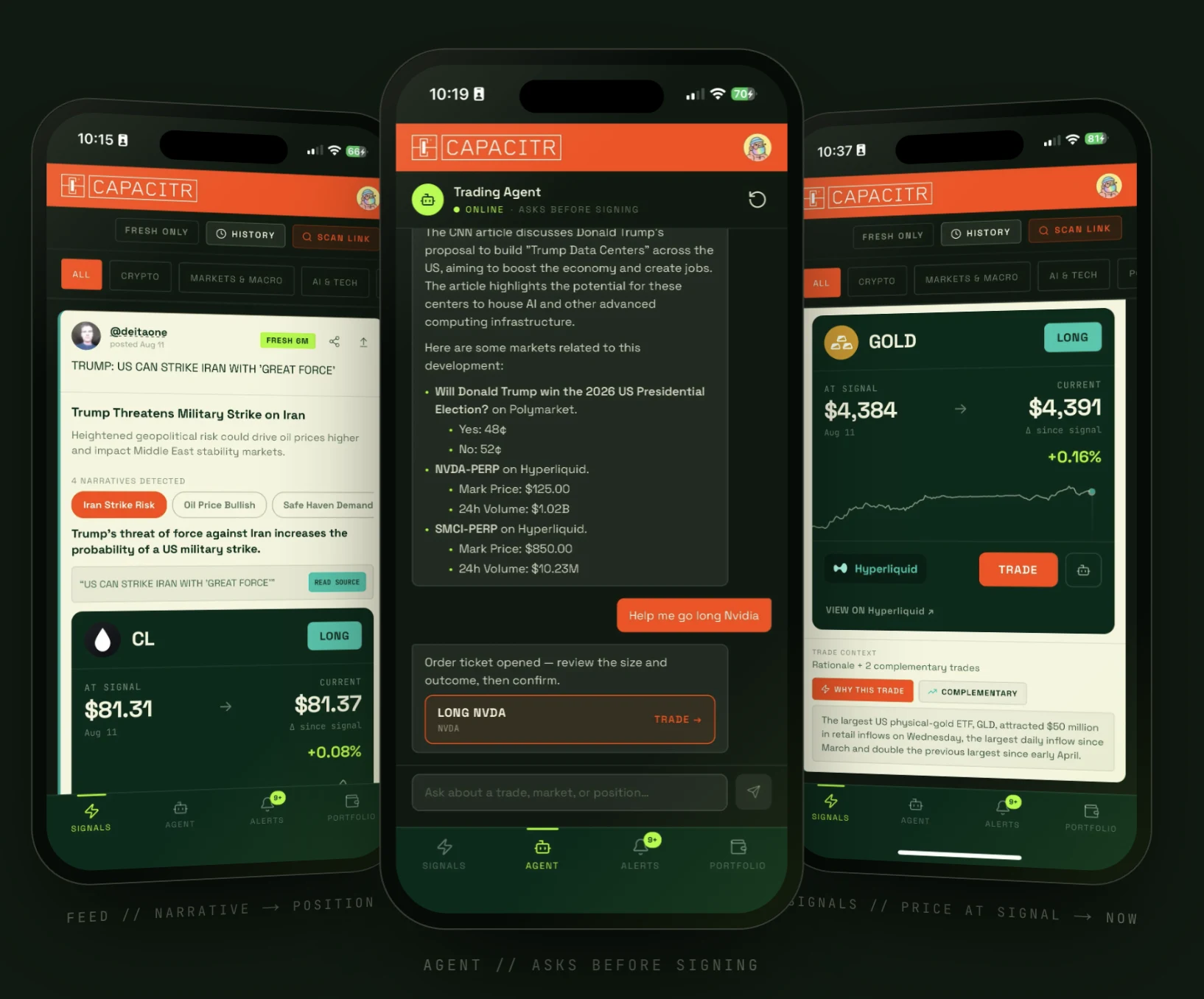
Six decisions in application code
Each Sage decision combines context with a question. The Surface column shows where that context comes from in Capacitr’s application; Sage output identifies the type of question asked. Sage returns a structured answer that the application can act on, as shown in Application decision.
| Surface | Sage output | Application decision |
|---|---|---|
| Publish gate | Tags | Classify content before market analysis. |
| Enrichment gate | Yes/No | Decide whether fresh research is needed. |
| Market ranking | Sort | Order matched markets by confidence and remaining profit potential. |
| Trade guardrail | Choice | Check that calls to eight money-moving tools trace to the user’s request. |
| Scope gate | Choice | Check whether a chat turn is in product scope. |
| Signal freshness | Scale, 0–4 | Assess whether a catalyst has passed or been overtaken. |
The outputs drive application behavior: stale trades are removed, ranked markets determine display order, and scope decisions constrain the agent. Each surface starts in shadow mode.
The team measured application performance before and after integrating Sage. They found that feed quality on production data remained as good. They then activated the decision gates and began saving inference costs.
Observed in the integration
- Under 100 ms per Sage decision, as reported by Capacitr across its six integration surfaces.
- Zero observed false positives across 152 audited money-moving tool calls.
- Zero reported vendor-side incidents over two months of production traffic.
Source
Capacitr’s integration write-up and subsequent figures supplied by its team, September 2026. Savings figures, latency, audited tool-call results, and incident history were supplied by Capacitr.
Build with Sage
Start with one decision.
Bring structured intelligence to your application.